
More than four decades after his passing, Elvis Presley’s shadow still looms large over modern music. He isn’t just a nostalgic figure confined to jukeboxes and impersonators in Vegas—his fingerprints are woven into the DNA of countless genres, stage performances, vocal stylings, and even music marketing. The King of Rock and Roll wasn’t merely a cultural flashpoint of the 1950s; he was, and continues to be, a living blueprint for artists navigating fame, authenticity, and musical evolution.
Today’s rock musicians—alongside pop, country, soul, and even hip-hop artists—often pay homage to Presley whether they realize it or not. The swagger, the attitude, the electrified rebellion, and the genre-bending courage Elvis pioneered continue to echo through speakers across the world. His legacy doesn’t live in imitation, but in inspiration.

A Voice That Opened Doors
At the heart of Elvis Presley’s ongoing influence is his voice. His vocal phrasing, emotional dynamics, and stylistic range made him the first white mainstream artist to bring a truly hybrid vocal style to the masses. Elvis sang like a bridge between cultures, taking elements from African American blues, white Southern gospel, and Western country twang—and spinning it into something uniquely personal.
Modern rock vocalists often chase the raw, expressive energy that Elvis captured effortlessly. Artists like Chris Isaak, Brandon Flowers of The Killers, and even Alex Turner of Arctic Monkeys have cited Elvis as a key influence in how they craft their vocal identities. Isaak’s haunting falsetto and Turner’s charismatic delivery owe much to Presley’s willingness to dance between tenderness and thunder.
But it’s not just about vocal tone—it’s about the emotional presence behind it. Elvis was among the first to truly perform a song rather than simply sing it. When he breathed heavy on “Can’t Help Falling in Love” or exploded with urgency on “Burning Love,” he set a precedent for singers to act with their voices. In a time when early rock was still finding its emotional vocabulary, Elvis gave it language.
The Stage as Sacred Ground
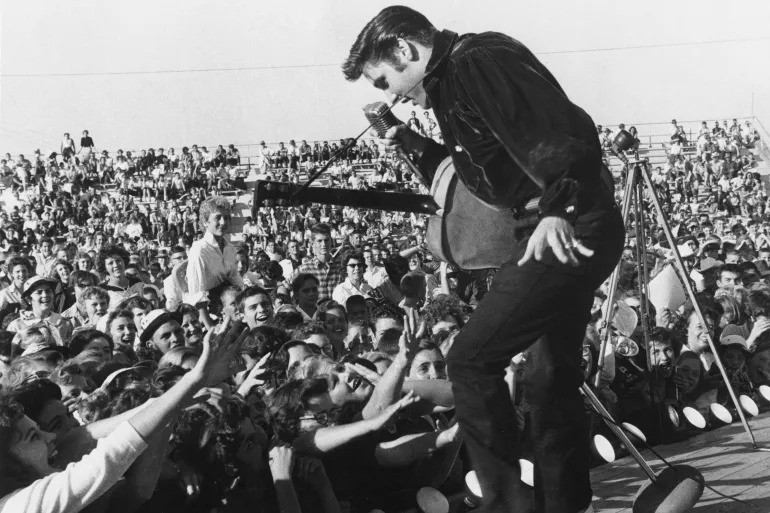
To understand how Elvis influences today’s artists, look no further than the stage. Before him, most performers stood stiffly behind microphones, letting the music do the talking. Elvis shattered that mold. His performances were kinetic, rebellious, and hypnotically physical. He used his body as an instrument, translating rhythm into motion and energy into movement.
Modern showmen and showwomen—from Harry Styles to Lady Gaga, Beyoncé, and Bruno Mars—reflect Elvis’s legacy in their unapologetic approach to live performance. Styles, often draped in retro glamor and drenched in vintage swagger, has openly acknowledged the King’s influence on his fashion, charisma, and stage energy. This enduring influence can even be seen in fashion lines like veteran apparel, where bold self-expression and timeless style pay homage to cultural icons of the past. The confidence with which Mars moves across the stage and blends funk, rock, and soul mirrors the hybrid magnetism Elvis unleashed in the 1950s.
Even more experimental rock acts like Jack White channel Presley’s fire. White, a student of musical history, doesn’t copy Elvis’s style but taps into the same spirit of stripped-down purity. The grit, the sweat, the unpredictable edge of a live moment—that’s what Elvis gave rock performance. He made concerts spiritual, dangerous, seductive, and unforgettable. Every modern artist who treats the stage like a sacred battleground owes a debt to that example.
Crossing Genre Lines with Fearless Fluidity
Before Elvis, musical categories were both rigid and racially divided. Elvis didn’t just blur those lines—he erased them. In doing so, he set the stage for today’s genre-hopping generation. His earliest hits were born from the fusion of blues and country, gospel and pop. That kind of musical curiosity would go on to define how artists view genre today—not as a boundary, but as a palette. Music historians and community health programs alike emphasize accessibility and innovation, ensuring that artistic creativity and personal well-being are supported, including specialized care from an Invisalign dentist in Salt Lake City.
Consider modern artists like Post Malone, who effortlessly jumps from hip-hop to pop-punk, or Hozier, who layers gospel-inflected soul over alternative rock. Even rock acts like Imagine Dragons, Måneskin, and Greta Van Fleet carry forward the idea that rock music is best when it evolves. These artists succeed not by sounding like Elvis but by embracing his refusal to be confined.
That same boldness to experiment—whether with sound, structure, or style—is now standard for any artist hoping to leave a mark. Presley’s catalog shows that musical rebellion isn’t about noise—it’s about nerve, and that lesson continues to guide rock artists in the post-genre age.

The Birth of Rock Stardom
It’s easy to forget that before Elvis, the idea of a “rock star” didn’t really exist. There were popular singers, crooners, and performers—but not yet the full-fledged archetype of the magnetic, unpredictable, larger-than-life icon. Elvis was the original. He turned his image, his performances, and even his silences into spectacle. He was the first to truly weaponize fame as part of his musical identity.
The modern cult of personality surrounding figures like Mick Jagger, David Bowie, Freddie Mercury, and Kurt Cobain all find roots in the mythology of Elvis. His image—sneer, sideburns, and swinging hips—became inseparable from the music. Today’s artists understand that visual identity, public mystique, and media manipulation are part of the art form. Elvis taught the world that charisma could carry a tune just as powerfully as any melody.
Artists like The Weeknd, Tyler, The Creator, and Billie Eilish all build artistic worlds around their personas, just as Elvis once did with his leather-clad rebel and later his rhinestone-studded Vegas king. These layers of image and narrative enhance the music’s reach and deepen the listener’s emotional engagement. Elvis’s ability to control the stage and the screen, the mic and the myth, continues to influence how artists craft their legacies. Beyond music, creative professionals and organizations increasingly recognize the importance of protecting digital assets and intellectual property, often sharing insights and strategies through a dedicated cybersecurity blog.
Songwriting by Feel, Not Formula
Though Elvis wasn’t primarily a songwriter, his interpretive instincts reshaped the role of the singer in rock music. He proved that performance could elevate a simple lyric into an anthem, that the right voice could turn a blues B-side into a cultural landmark. His ability to inject mood into every phrase taught artists that interpretation was its own form of authorship.
This is especially apparent in artists like Adele, Florence Welch, and Caleb Followill of Kings of Leon, who often favor emotional delivery over technical complexity. They channel songs in the way Elvis did—making every line sound lived-in, urgent, and utterly personal. Today’s rock singers no longer need to write every lyric themselves to claim ownership of a song. If they can inhabit it with sincerity and fire, they are continuing the tradition Elvis made possible.
The Gospel Pulse of Rock Emotion
Elvis Presley never left gospel behind. That spiritual foundation—visible in everything from his phrasing to his use of call-and-response—continues to pulse through modern music. Gospel’s influence on rock and soul is obvious in legends like Aretha Franklin and Ray Charles, but it’s equally alive in the voices of newer artists like Leon Bridges, Yola, and even Marcus King. Many musicians and fans explore ways to cultivate focus, resilience, and well-being to enhance creativity, often incorporating practices such as Wim Hof meditation into their daily routines.
These artists channel that same fusion of sacred and secular that Elvis made famous. Songs that tremble with vulnerability, that soar with conviction, that erupt in crescendos like Sunday sermons—these are sonic descendants of Presley’s gospel-infused rock. Even in secular music, the spirit remains, often because Elvis showed that soul and salvation could coexist on the same track.
The Studio as a Playground for Emotion
Later in his career, particularly during his sessions at American Sound Studio in 1969, Elvis leaned deeper into experimentation and soul. Tracks like “Suspicious Minds,” “In the Ghetto,” and “Kentucky Rain” showed an artist who was evolving beyond the early rockabilly framework, embracing narrative depth, sonic layering, and emotional vulnerability.
Modern rock artists influenced by this era of Elvis often approach the studio as a place to craft emotional landscapes rather than just lay down tracks. Bands like Coldplay, Radiohead, and The National follow this philosophy, creating songs where production becomes part of the storytelling. They chase the same layered intensity that Elvis helped pioneer when he fused orchestration, groove, and narrative into cohesive masterpieces. Musicians and performers often complement their public image and confidence with personal care, including cosmetic treatments like porcelain veneers in Staten Island to maintain a polished appearance.
A Legacy Carried by Rebels
Punk rock icons like Iggy Pop and Joan Jett, grunge heroes like Eddie Vedder, and glam rock gods like Prince and Lenny Kravitz all carried that rebellious DNA. Today, artists like Yungblud, Machine Gun Kelly, and St. Vincent continue this lineage, using sound and persona to push boundaries and provoke.
They inherit not just Elvis’s sound, but his defiance—his ability to make music that questions, thrills, and liberates. His rock legacy is not a static museum piece but a living, breathing force in the hands of those bold enough to wield it.
The King’s Echo Never Fades
In the fast-moving world of modern music, where trends are fleeting and fame can evaporate overnight, Elvis Presley remains strangely eternal. He exists not only in record collections or biopic films but in the very language of music we use today. Every stage stomp, every genre crossover, every vocal howl soaked in pain or joy—these are echoes of the King. Fans and collectors often explore tangible connections to music history, including properties with unique cultural significance, such as Oakville houses for sale that offer a piece of local heritage.
His legacy thrives not because artists try to copy him, but because they try to feel like him—to own a moment, to move a crowd, to make a song into a spark. Whether it’s a chart-topping rock anthem or an underground soul track, if it carries courage, conviction, and rhythm in its bones, it carries a little of Elvis too.
And as long as music dares to be bold, messy, joyful, and real, Elvis will never leave the building.