
German rock music has long been one of the most fascinating contradictions in the global music scene—deeply rooted in a specific national identity, yet often bursting beyond its linguistic and cultural confines. For decades, artists from Germany have grappled with the challenge of reaching international audiences in a language often considered too harsh or obscure for the pop-rock mainstream. Yet against all odds, many German rock bands have shattered expectations, drawing global fans not despite their language but often because of it.
This phenomenon didn’t happen overnight. The path from underground notoriety to international acclaim has been shaped by historical shifts, sonic innovation, unapologetic theatricality, and a new understanding of what makes rock music universal. In a world where English once dominated rock ‘n’ roll, German bands proved that authenticity speaks louder than any one language.

The Early Struggles of Linguistic Isolation
For most of the 20th century, English was the passport to rock success. American and British artists dominated charts, airwaves, and cultural imagination. Bands from non-English-speaking countries often felt pressured to sing in English to be taken seriously abroad. This was especially true in post-war Germany, where cultural reconstruction included adopting Anglo-American pop culture as a symbol of freedom and modernity.
During the 1960s and 70s, many German rock musicians either emulated British and American styles or sang in English outright. While this did help some bands achieve a modest level of success, it also created an identity crisis. The music was technically sound, but something was missing—something raw and real.
That all began to change with the advent of Krautrock, a genre that rebelled against both American rock mimicry and the sanitized commercial pop of the day. Bands like Can, Neu!, Faust, and Amon Düül II embraced experimentation, creating sprawling instrumental compositions with psychedelic, progressive, and electronic influences. Although they largely avoided vocals or used them sparsely, these bands laid the groundwork for what German music could become: challenging, innovative, and uncompromisingly itself.
Scorpions and the Global Language of Guitar
The band that arguably cracked the code for German rock success abroad was Scorpions. Formed in Hanover in the 1960s, Scorpions made the bold decision to sing in English, not out of cultural deference but as a strategic move. With high-octane riffs, piercing vocals, and melodic power ballads, they managed to balance technical mastery with emotional resonance.
Songs like “Rock You Like a Hurricane” and “Still Loving You” became global anthems in the 1980s, and their 1990 hit “Wind of Change” became emblematic of the fall of the Berlin Wall. While Scorpions didn’t challenge the language barrier so much as bypass it, their international acclaim put German rock on the map and opened the door for artists who would later embrace the German language without compromise.
Rammstein: Turning the Language Barrier Into a Weapon
No discussion of German rock’s global rise would be complete without Rammstein. Emerging from the ashes of East Germany in the mid-1990s, Rammstein took everything that was supposedly unmarketable—harsh German lyrics, industrial sounds, and militaristic stage imagery—and transformed it into a global phenomenon.
What made Rammstein stand out wasn’t just their music, which fused metal, electronic, and orchestral elements into a genre now known as Neue Deutsche Härte (New German Hardness). It was their ability to make the German language itself a powerful instrument. Lead singer Till Lindemann’s deep, snarling delivery turned every guttural syllable into an act of aggression or seduction, often both at once.
Songs like “Du Hast”, “Ich Will”, and “Sonne” achieved massive popularity far beyond German-speaking countries. Fans in South America, Asia, and North America sang along phonetically at sold-out shows, mesmerized by the drama and intensity even if they didn’t understand every word.
Rammstein didn’t merely break the language barrier—they weaponized it. Their success proved that emotional authenticity, stagecraft, and sonic identity could transcend linguistic limitations. The German language, once seen as a disadvantage in the pop world, became their greatest asset.

The Rise of Deutschrock and New National Confidence
As Rammstein paved the way for non-English German bands, the early 2000s saw a new wave of rock acts embrace their native language without apology. This movement, often labeled Deutschrock, combined classic rock structures with introspective, socially charged German lyrics.
Bands like Silbermond, Juli, and Wir sind Helden emerged with heartfelt lyrics, catchy melodies, and a distinctly German emotional sensibility. They didn’t need to sing in English because they weren’t trying to conquer the global charts—they were writing for a post-reunification generation hungry for cultural self-expression.
At the same time, bands like Sportfreunde Stiller and Madsen began gaining traction with both domestic and international audiences, especially in Europe. Their use of the German language didn’t alienate listeners; it invited them into a different worldview, one shaped by precision, poetic structure, and a kind of lyrical honesty difficult to replicate in English.
The growing success of these acts marked a turning point. German was no longer a liability—it was a badge of artistic integrity.
Tokio Hotel: Youth Culture and the Language Switch
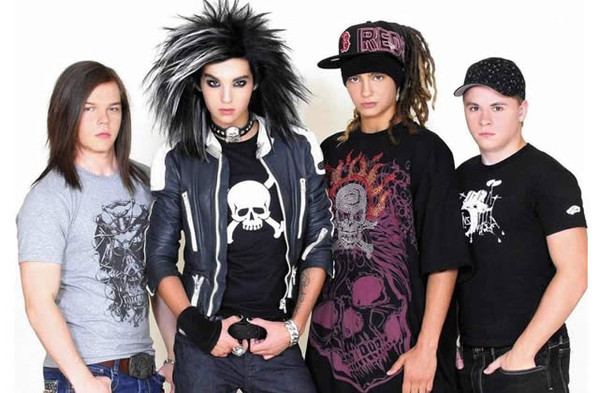
Among the most intriguing case studies in the globalization of German rock is Tokio Hotel. Initially rising to fame in the mid-2000s with their debut album “Schrei”, the band captured the hearts of German teenagers with raw emotion and gothic-pop aesthetics. Songs like “Durch den Monsun” topped German charts and built a massive domestic following.
But what set Tokio Hotel apart was their conscious switch to English for their international releases. Albums like “Scream” helped them break into the American market, where they cultivated a large teen fan base—especially among those drawn to their androgynous image and emotionally charged lyrics.
While some critics accused the band of compromising their roots, others argued that their bilingual approach demonstrated a new kind of cultural fluidity. Tokio Hotel’s global rise, especially in Latin America and Eastern Europe, showed that young audiences weren’t put off by accents or translated lyrics—they were drawn to vibe, identity, and emotional connection.
Festivals, YouTube, and the Algorithmic Bridge
One of the most significant factors helping German rock cross linguistic borders in the last two decades has been the internet. Platforms like YouTube, Spotify, and TikTok have flattened the playing field, allowing international fans to discover bands without needing major label marketing.
Suddenly, a song like “Engel” by Rammstein or “Wenn Worte meine Sprache wären” by Tim Bendzko could go viral thanks to a single video or playlist inclusion. German-language rock found itself exposed to listeners who, through algorithmic serendipity, were no longer confined by cultural silos.
Major European rock festivals like Rock am Ring and Wacken Open Air have also helped amplify the global reach of German rock. International attendees often leave with new favorites, even if those bands sing entirely in German. The experience of seeing a powerful live show—full of emotion, sweat, and sonic fire—often outweighs the need to understand every word.
Music as a Universal Language, Reimagined
Perhaps the most enduring lesson of German rock’s rise across borders is this: emotion travels faster than translation. While lyrics matter—and can profoundly deepen a fan’s connection—what draws people in initially is tone, mood, energy, and personality. German rock bands have excelled at delivering all four.
Whether it’s the polished arena grandeur of Scorpions, the apocalyptic fury of Rammstein, or the introspective honesty of modern Deutschrock bands, what connects audiences is the sense that the music is real. Language may shape how a message is conveyed, but it doesn’t have to dictate whether that message gets through.
Even in cases where German bands have chosen to record English versions of their songs, as Rammstein occasionally has, those versions are often seen as supplementary—not replacements. Fans across the globe continue to embrace the original German versions, singing along syllable by syllable, no translation needed.
A Sound That Speaks for Itself
As globalization redefines what it means to be a “local” or “international” artist, German rock music stands as a compelling example of how language doesn’t have to be a barrier—it can be a bridge. Through bold artistry, emotional sincerity, and often explosive live performances, German rock bands have shown that music doesn’t need subtitles to speak directly to the soul.
From the stormy poetry of Neue Deutsche Härte to the anthemic choruses of Deutschrock, Germany’s rock scene has not only found its voice but shared it with the world. And that voice—powerful, loud, and unmistakably German—continues to echo far beyond its borders.